

Auditing and hardening nginx on a VPS: know your version, shrink the surface, verify Published on August 12, 2026 Two heap overflows landed in nginx’s script engine within a few months of each other this year, and the second caught plenty of people who had already patched for the first. That is not a patching failure. It is an inventory failure: not knowing precisely what you run, where. This is the routine that fixes that. It takes about twenty minutes the first time, and two minutes a month afterwards.

1. Know what you actually run

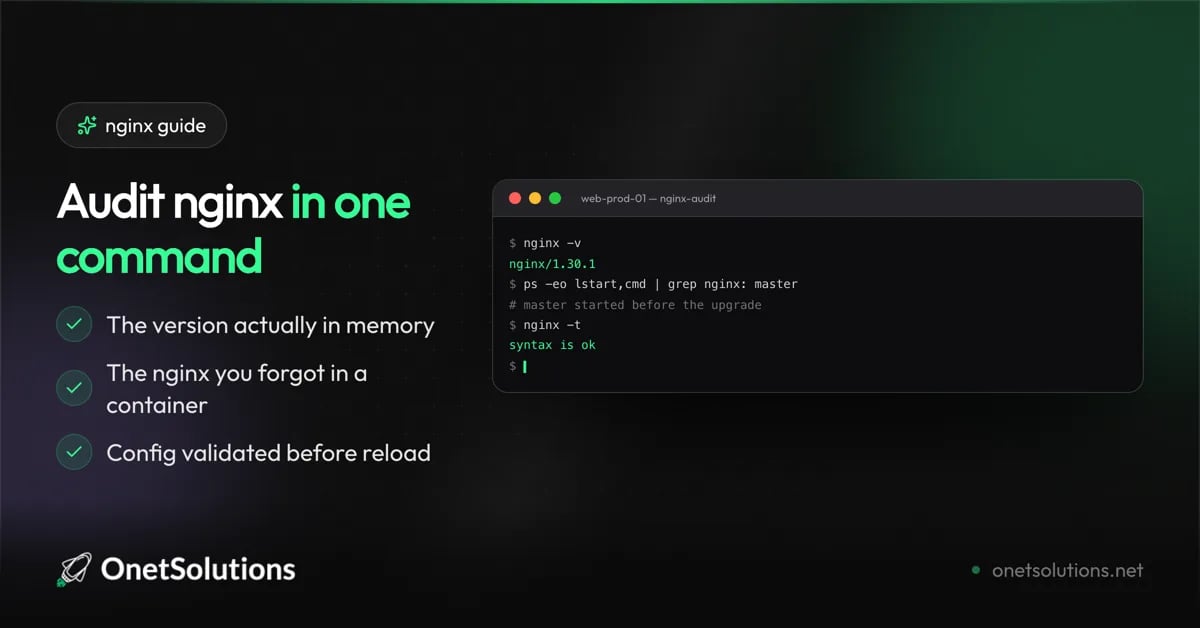
The single most useful fact, and the one most often wrong. Your package manager’s opinion is not the same as the binary on disk, which is not the same as the code in memory.
If the third command shows a master process older than your last update, you installed a patch and never restarted. The old binary is still serving traffic. This is the most common gap between “patched” and “safe”.
nginx -s reload does not replace the master process. After a package upgrade, use systemctl restart nginx. Reload is for configuration changes, not binary changes.

2. Inventory every nginx you forgot about

The nginx you patch is rarely the only one you run. Containers pin their own copies, and pinned tags never move on their own.
A pinned nginx:1.30.1 is frozen until you rebuild. If your compose files pin exact patch versions, patching is a code change and belongs in your deployment routine, not your server routine.

3. Shrink what is exposed

Most nginx advisories affect a specific module or directive. The fewer of them you use, the fewer advisories are yours. Start by seeing what your build even includes:
Then check what your configuration actually reaches for. The two heap overflows this year both lived in the script engine — map, rewrite, and regex captures:
This is not a reason to avoid map — it is a good directive. It is a reason to know whether an advisory naming it concerns you, in seconds rather than an afternoon.

4. Stop advertising your version

nginx returns its exact version in every response header and error page by default. That turns any scan into a targeted list.
This is not a security control — it does not fix a single bug. It is a cost control: it moves you out of the trivially-enumerable set, which is where mass exploitation shops for targets. Confirm it took effect:

5. Set the headers that cost you nothing

Four headers, no downside for the vast majority of sites:
Strict-Transport-Security is a commitment. Once a browser has seen it, it refuses plain HTTP for your domain for the full max-age. Only add it when HTTPS works everywhere on the domain, including subdomains, and start with a shorter max-age if you are unsure.
The always keyword matters: without it, the headers are dropped on error responses, which are exactly the ones an attacker sees most.

6. Put a ceiling on request size and rate

Defaults are generous because nginx cannot know your application. An upload endpoint that accepts 1 GB when your largest legitimate file is 5 MB is free ammunition.
Tune the numbers to your application rather than copying them. The point is that a number exists.

7. Verify, then make it routine

Never reload on an untested configuration:
Then reduce the whole audit to one command you can run monthly:

What this actually buys you

None of this prevents the next heap overflow in the script engine. Nothing you configure will. What it buys is the ability to answer, in under a minute, the only question an advisory really asks: is the version I am running inside the affected range, everywhere I run it? Teams that can answer that patch in an afternoon. Teams that cannot spend a week finding out, and usually miss a container. Two habits carry most of the weight: restart after a package upgrade, and treat pinned container tags as code that needs updating. Related reading: our advisory on the two nginx heap overflows and the enhanced VPS security guide for the layer underneath. Questions about a server hosted with us? Our team is available from your client area.